|
|
skip to main |
skip to sidebar
Dashiell Hammett, along with Raymond Chandler and Ross Macdonald, are considered the three pillars of classic American hard-boiled writing. Hammett came first, however, and pretty well perfected the genre and writing style when it was still in its infancy. As much as the latter two authors leaned on him, to my mind they never surpassed him. He was the best.
I am not
the first to note the curious fact that Hammett published five mysteries in
five years, one of them among the greatest novels ever written, then never
finished another book for the remaining 27 years of his life. No one ever
really figured out why, including Lillian Hellman, his companion during those 27
years, though alcoholism, tuberculosis, and persecution by the US government (Hammett
spent time in jail due to his political beliefs) are among the chief suspects. (A
new collection of his short fiction, The
Hunter and Other Stories, reveals that Hammett may have been hoping to
shake the tough-guy image and write something completely different, but the
stories failed to interest editors, hence their publication now for the first
time.)
His first
novel, Red Harvest (1929) has a standard-issue
feel at the opening, when an unnamed private investigator arrives in
Personville (aka "Poisonville") at the behest of an influential
client whose life has been threatened. The client is killed before they meet,
but his father hires the PI to find his son's killer. The suspects number a
greedy girlfriend, a crooked chief of police, the victim's wife, and several of
the town's gangsters. So far, so ordinary. But that's where things start to
change, and before long you realize you're in the hands of a master of two of America's
favourite themes: violence and vengeance. The PI quickly learns he can't trust
anybody, including his employer, who first asks him to clean up Personville
then orders him to leave town. After one-too-many assassination attempts,
however, the PI is unwilling to vacate: now it's personal. "All in all
it's one swell dish," is how one character sums things. And that's how the
nameless PI deals it, serving up first one gangster after another in his
unbending quest to restore law and order. The protagonist has strong
similarities to Sam Spade, Hammett's most famous creation, but other characters
from his third and best-known volume, The
Maltese Falcon, also find their prototypes here, in this powerful and highly
engaging story.
The Dain Curse followed the same year, in what may have been
an attempt to cash in on the success of its predecessor. For his second book, Hammett
threw everything into the cauldron: family curses, religious cults, drug
addiction, stolen jewels. You name it, it's there. And not to the book's
credit. Perhaps Hammett felt paralyzed by his beginner's luck and tried to
figure out just what makes a book work with this second volume. Another
nameless PI serves as the writer's alter-ego, making him sound at times like an
author in search of a convincing psychology of character and event, voicing the
story's apparent contradictions while testing some possible plot permutations.
All in all, it's one big mess. But, what's more intriguing: that this book is
one of the least enjoyable works of detective fiction of all time or that Hammett's
next would be the greatest?
Of his
third and most successful book, The
Maltese Falcon (1930), I cannot say enough. Its story of greed and
treachery, as characters play one another off in quest of the famed "black
bird" of Malta,
has inspired me and countless others to imitate its perfection and mastery. It
is at times funny, cruel, compassionate, bleak, insightful, and riveting. Many
will know the John Huston-Humphrey Bogart collaboration that also made it one
of the most famous movies of all time. And rightly so. To Hammett's everlasting
credit, much of the filmscript was lifted straight from the book, and it all works
beautifully even now. The combination of oddball characters, wickedly funny
dialogue and immaculate plotting make this the perfect noir masterpiece, as PI Sam
Spade avenges the death of his partner Miles Archer and makes the world seem
right in a cock-eyed, cynical kind of way. It was ranked 56 in Modern Library's
100 Best English-Language Novels of the
20th Century.
Hammett's
fourth book, The Glass Key (1931), is
an oblique tale written in a completely different tone from his earlier work.
It's as though abstract expressionism has infected his style. Tension is
rampant, but with little or no emotional anchoring between reader and characters.
Here, all is ambiguity: Ned Beaumont, a racketeer, is asked to investigate the
death of a respected senator's son by his best friend, a crime boss who wants
to marry the senator's daughter. Politics and crime intersect and bisect repeatedly
as the story grows more and more convoluted, until nearly everyone's motives
are suspect. The purposeful withholding of the characters' rationales contributes
to a sense of overall unease, where the reader never knows whom to trust,
though both the story's end and the murder reveal are neatly fitting. This was
said to be Hammett's favourite of his books.
Three years
passed before the publication of The Thin
Man (1934), Hammett's last novel. His sense of humour is back and smarter
than ever, but there is an additional element in the work: love. The writing of
this book happened to coincide with his relationship with playwright Lillian
Hellmann, Hammett's companion for the last 30 years of his life, and to whom
the book is dedicated. Here, the protagonist is Nick Charles, a former-private
investigator who spends his time partying and drinking with his clever young
wife, Nora. Against his will, Nick is drawn into a murder investigation along
with Nora. The couple are fun and lively and seemingly free of sexual inhibition,
as their frank (for the times) sexual banter--including comments on male genitalia--proclaims. The relationship is also
refreshingly free of traditional sex role stereotyping, another miracle for its
dour era. This is Hammett's happiest book and a fitting epitaph for one whose life would
eventually take a permanent downslide into illness, incarceration and disillusionment.
A night on the town with Luba Goy, star of the Royal Canadian Air Farce, invariably turns into a Magical Mystery Tour. Last night, singer-actor Dorothy Post and I joined La Goy at one of her fave hang-outs, the Wish Cafe on Charles Street East, where she soon had the staff bending over to accommodate her every, erm, wish.
After a tasty meal, plus a brief interlude that consisted of a comparison of luxury lingerie (with Dorothy, not me, but who knew you could spend so much on a brassiere?!), we were off to catch Luba's friend and colleague Bruce Dow deliver a bravura performance in Tim Luscombe's Pig, given its impressive premiere at Buddies In Bad Times Theatre under the sure hand of director Brendan Healy. (If the MORE link doesn't work, click on BLOG above.)
In search of dessert and further adventure we soon landed at a Toronto landmark, Fran's on College Street, where we found ourselves sitting next to film/television actor Eve Crawford, who dropped in with artist/videographer Max Deans. That was how we chose our next stop in the night's madcap roundup: Max's Cancer Is Our Story, a riveting video installation featuring multiple hands and arms in tightly choreographed movements. The video, which repeatedly won applause from passersby, was a major Nuit Blanche exhibition on University Avenue across from Princess Margaret Hospital.
While there, La Goy was mauled by media-guru George Stroumboulopoulos, just one of thousands roaming the streets and checking out the artistic offerings on display. (BTW, Luba is a scheduled guest on George's show this Wednesday night on CBC--don't miss them!)
Of course, the night couldn't end there. We next grabbed a cab and swung all three blocks over to the Eaton Chelsea to round up my friend Eslam, who had just texted to say he was free. (The more the merrier!) Eslam, a veteran of the Libyan civil war, is currently receiving medical treatment in Toronto and has become a big fan of all the city has to offer. He knows Canada is a very cool country!
Cabbing it again, the four of us trekked off to city hall to view the extraordinary large-scale Ai WeiWei work, Forever Bicycles, made up of 3144 interlocked bikes erected at the centre of Nathan Phillips Square. Having seen the full Ai WeiWei exhibition currently on at the Art Gallery of Ontario, this final piece capped for me the work of one of today's most impressive and relevant living artists.
Thanks to the great weather, the square was packed well past 2 AM. I don't think it's ever looked so good. Come to think of it, the city hasn't been this much fun either for a very long time. But that's just what happens when you venture out with Luba Goy.
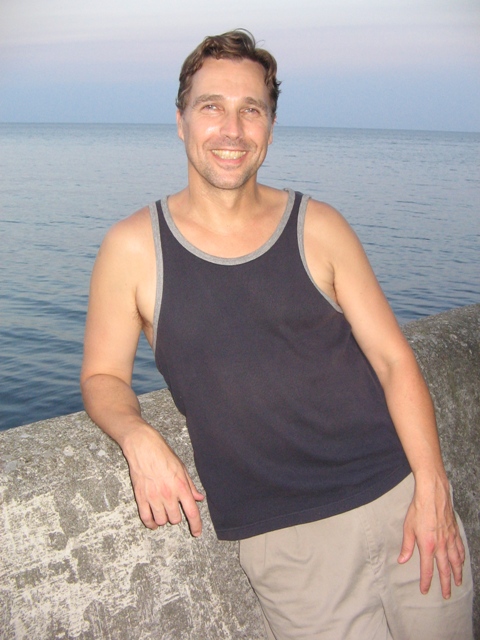
(All fotos by moi, except for the promo shot of actors Bruce Dow and Paul Dunn. Oh yeah, duh, and the one with me in it, taken by the Lovely Luba.)
Readers often ask where I get my characters. The truth is, I don't know. While I may steal a visual from life once in a while--a nice head of a hair, a good jaw line--I don't use real people when it comes to personality. Nor are they all some version of me. If I made a list of what my character Dan Sharp and I have in common, it wouldn't be long. I am not a single dad, a private eye, or a kid from the wrong side of the tracks. Nor did I ever sell my body for sex, though I have slept on a park bench.
Growing up in Sudbury, as Dan I and did, there was no small share of potential characters: boys whose fathers were alcoholics; a girl named Shirley who had a boy's haircut and wore dungarees and came to school looking alternately frightened and angry; another girl named Pelka, whose father emigrated from Yugoslavia and who drank battery acid to try to kill himself. I knew that world and mingled with it every day at school. I never thought any of them odd--merely interesting or dull, dangerous or friendly. Nor did I ever look down on any of them.
On the other hand, like Dan, there is a little of the sleuth in me. I recall Miss Kristakos, my grade three teacher, who had polio and limped, and who I secretly followed home one day to find out where she lived so I could surprise her with a drawing of Daisy Duck the next day. Or Rex, my best friend of two months, who had no father and whose mother was so poor all she could afford to serve when I came to lunch was Kraft Dinner, which I refused as politely as I could. Rex vanished as suddenly as he appeared. The adult me still wonders how I could trace him to learn how his life turned out, as would Dan.
While I'm not Dan, I admire him and like to spend time in his company. That's why I write about him. I've had an easier life than he has, and that's one of the reasons I admire him, because he upholds principles despite the difficulties they sometimes cause him. If I knew him, I would be proud to call him my friend. I hope he would say the same of me.
The Beast Without by Christian Baines (Glass House Books)
I'd never seen True Blood or read a vampire novel. Never wanted to. Not out of snobbishness, but simply lack of desire. The only vampire film I ever enjoyed was Andy Warhol's Dracula (which is actually Paul Morrisey's Andy Warhol's Dracula, but I won't belabour that.)
After a recent Pride reading, however, I was approached by an attractive young man. He complimented me (I like being complimented by attractive young men) and said he'd just published his first novel, a supernatural fiction story. I said I would read it. (Yup, that's all it takes, Sorry.) Happily, surprisingly, I enjoyed it. In the hands of a born storyteller like Christian Baines--especially one with such a wickedly subversive wit--I suspect any story would come alive.
Baines' book gives credence to my theory that genre is the new playground of the literary imagination. (Nothing truly new, of course: Mary Shelley's Frankenstein is a great novel and was so long before we knew there were genres.) Likewise, The Beast Without is sexy, sassy and fun. The story never flags as we follow Reylan, an "out" Blood Shade, as he roams Sydney's gay community.
Ironically, Reylan unintentionally finds himself attracted to a closeted, homophobic werewolf named Jurgas whom he has vowed to kill. What's a boy to do, even if he's 153 years old? The tension and intrigue just keep ratcheting up. Kudos to a new writer who will leave his marks on the publishing world, if not on your neck. If genre fiction is in the hands of writers like this then long live the new genre. No stake through the heart can put an end to it.
This year's Pride was one of my most enjoyable ever. I watched Sunday's parade with Susan G Cole of NOW Magazine, and my young friend James, who I met through Supporting Our Youth (SOY), an LGBT youth mentoring program run by the Sherbourne Health Centre. Both Susan and I recalled the first Toronto Pride in 1981 (I still have the orange souvenir invitation), while James enjoyed his first ever this year. (He really scored big on the souvenirs tossed from the various floats.)
Earlier, I read at the Proud Voices Program hosted by Glad Day Bookshop, the worlds oldest--and best!--LGBT bookstore, alongside Liz Bugg, Cathi Bond and JP Laroque. Some terrific readers, let me tell you! The event was hosted by the charming Michael Erickson, one of the store's new owners. I read from my Lambda Award winning novel, Lake On The Mountain (Dundurn), and followed it with a snippet from the sequel, Pumpkin Eater, due next spring.
Please -- if you're a fan of LGBT writing -- remember to support the store. They deserve it and need it now more than ever.
Here's to next year's World Pride! Cheers, Queers!
Now I know what it feels like to win something that has meaning for me. Thanks to the folks at the Lambda Literary Awards, I am the recipient of a beautiful crystal tablet inscribed with my name and the title of my most recent book: LAKE ON THE MOUNTAIN. It's meaningful to me for a number of reasons, not the least of which is that the award is juried by my peers, people who know what it takes to labour over words in an attempt to create something meaningful and beautiful, inspiring and wise. When I got home, I put it on my mantlepiece to remind me why so many of us continue to write even when the rewards and the acknowledgements are few and far between. That's why I'm so grateful for this particular award.
The ceremony, held in New York on June 3, was an uplifting celebration of talent and labour, as well as a testament to the perseverance of the LGBT community itself. We need no reminder that this community has had more than its fair share of fights to exist and prosper. I'm grateful to have been so honoured and hope I can continue to do what I love while contributing to the community in return.
Ever wonder what it's like to be gay in other countries? It's not always so easy, as I discovered during several recent trips to Cuba. In North America and Europe, we take a lot for granted that other LGBT folk can only dream about. Here's my first-hand report from the streets of Havana, as published in the Xtra!: http://www.xtra.ca/public/National/Finding_gay_Havana-13525.aspx
|
|