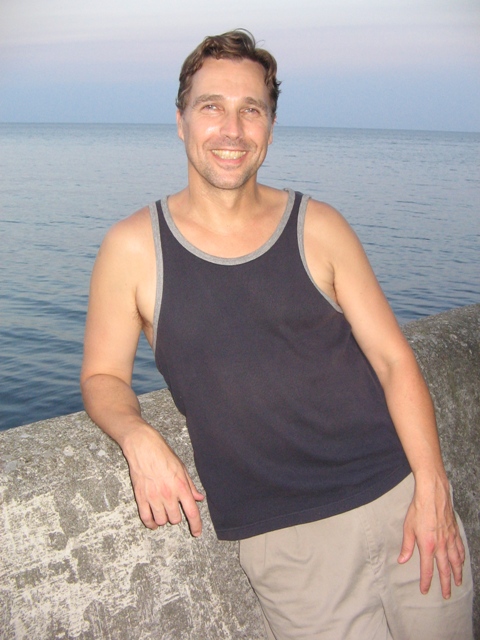
From Cancún to San Cristóbal de las Casas
(photos: http://www.flickr.com/photos/29261658@N03/ )
It can be difficult to come home after a good trip, but this time I found it particularly hard. To finalize portions of a book I have coming out this fall (The Honey Locust, Cormorant Books), I travelled to Chiapas, Mexico’s southernmost state. It’s such a far-out place, I almost feel I’m not part of this world any more.
Chiapas is not highly travelled by tourists and almost everything is inexpensive. Part of the reason is that this is where the Zapatista Liberation Army (EZLN) staged its anti-globalization protests in 1994. As a result, much of the state is now under armed rule, a heavy-handed monitoring (and occasional torturing and murder) of the goings-on of the Indigenous people, who lead impoverished lives, being both poorly educated and malnourished. Perhaps not surprisingly, the US financially supports the Mexican government’s suppression of these people to help maintain NAFTA’s stability. I’m not aware if Canada does the same directly, but we are still NAFTA-ites.
To get to Chiapas, we travelled by car from Cancún, west through Mérida and down past Campeche, a coastal city with two walled fortresses. From there we continued to our final destination of San Cristóbal de las Casas, a beautiful city of light and colour ringed by mountains and reminiscent of Florence with few traces of tacky Tijuana-style Mexico. It’s cool there—the average nighttime temperature was about 15 degrees. Seeing people in ski jackets and toques, even in the daytime, was not unusual.
Our total driving time was 17 hours each way, so we got to see a lot of the country, including some spectacular mountain vistas. Needless to say, the drive is not for the timid unseasoned tourist (most of it is unlighted and often unmarked) or for those with plain old bad karma.
Chiapas is home to Palenque, one of the granddaddies of Mayan ruins, set in the jungle at the foot of the Chiapas highlands. You can explore the ruins in relative peace—they’re not over-crowded and the tourists who go tend to be respectful. Another set of nearby ruins is the often-overlooked Toniná, once a political rival to Palenque, situated just outside of Ocosingo. Though less complex, I found these ruins more impressive than Palenque because of the majestic views of the valley and surrounding mountains from the top of the pyramid (which you can no longer climb at highly visited sites like Chichén-Itzá.) While there, Shane and I were invited to participate in a spirit-raising ceremony sung/chanted in a Mayan tongue and addressed to the four directions: west for thoughts, east for emotions, north for characteristics and south for personality.
For me, the most memorable part of our journey came with a horseback ride to a small native settlement, San Juan Chamula, situated in the hills just outside San Cristóbal, which gave us our biggest insight into the life of the modern-day Maya. A very poor town, the superb and highly colourful crafts seemed to be the biggest source of income. Though the townsfolk were welcoming, we were warned by our guides not to take pictures of the natives, who believe photographs steal their souls, as well as of the church interior. To disregard these laws (they are actual state laws) can result in a fine or jail sentence. It was difficult, but I managed to restrain myself from snapping a few photos in secret.
The interior of the church at San Juan Chamula is like no church I’ve ever seen. Though it has the requisite portraits of saints, it’s very different from a traditional church. The pre-Christian Maya worshiped a tree they called the World Tree, which they dressed in human clothing on festival days. When the Spanish imposed Christianity on them, the Maya combined the World Tree with the cross, to maintain their own religion while satisfying the demands of the conquistadors. To this day, the crosses in and around San Juan Chamula are all strapped to pine trees.
When you enter, the first thing you notice is that the floor of the church is covered in pine needles and hundreds of burning candles. The air is filled with smoke and lit by the glow from the candles, which you must step around as you walk. There are no pews. People sit on the floor or huddle in prayer over the candles. If you look closely you might see a shaman cracking an egg over someone with an affliction (in order to draw off evil), or, for more serious causes, decapitating a chicken, which is kept in a cloth bag to keep it quiet until it’s needed for the sacrifice. You will also see people “purifying” bottles of Pepsi or spring water by revolving them over the candle flames—their version of holy water.
At another small mountain town, Zinacantán, is a series of hills (bumps, really, in the larger scheme of things in that area.) This is where the Maya believe the world started, and which they call the “navel of the world.” It’s now an artistic community as well as a home for numerous greenhouses that supply flowers to florists to the north.
I had brought glittery pencils to give out in some of the small villages on the way (the children will barricade the roads until you give them something or risk running them down.) The mothers in particular were grateful, and often asked for more for children at home, though far more than pencils are needed to help these people.
Despite their impoverished lives and primitive living conditions, the people are always impeccably dressed and well groomed. You can tell the differing tribes by their clothing. (You can even tell things like marital status—an unmarried Zinacantecan man, for instance, will leave the ribbons of his hat untied.) Though we occasionally felt resentment in some of the poorer areas, we never felt unsafe, except when we were stopped and questioned at the military checkpoints (which only happened if we travelled after dark, which we quickly learned not to do.)
Driving back to Cancún, we spent a few days on the Mayan Riviera, which was so over-crowded with tourists it seemed to have little to do with the real Mexico. We made a day trip to a cenote (a cavern filled with fresh water, part of a vast system of underground limestone caverns stretching throughout the Yucatán Peninsula.) Judging by the artefacts left behind, this one was determined to have been a place of (non-human) sacrifice serving various purposes, such as supplicating the gods for fertility or rain. We were even able to kayak in one of the underground caves before heading back home.
February 25, 2009

January 20, 2009
THE MEDIA HAVE LANDED
Something important I learned recently: if you put it out there, it will get heard. My on-line comments about an Albright-Knox Art Gallery event last September (one piano being dropped onto another piano with musical accompaniment) were recently cited in the Buffalo News “Arts Beat” blog. Naturally, I was impressed that my little entry was noticed, let alone publicized.
So here’s another…
In the summer of 2007, I watched a CBC news documentary on the “coming financial crash.” It seemed the media had got tired of promoting the coming “bird-flu pandemic” and the coming “Taliban take-over” and latched onto something juicier: money—a topic we can all relate to. Citing a stagnant market in the US, the item gloomily predicted an imminent and drastic drop in Canadian real estate prices.
Over the next few days, as I fretted about this impending loss to my property value, I began to notice a disproportionate number of properties coming onto the market. The media, it seemed, had sparked its own little “crash” as people tried desperately to unload their properties before they deflated.
Flash forward a year and a bit: everywhere you looked was news about the worldwide financial crisis. While it’s true that lost jobs and struggling economies are not simply a media fabrication, here’s the odd thing: I, who years ago vowed to dedicate myself to writing rather than hording money or working for corporations (my own little vow of poverty), suddenly found myself panicked over the crisis. I, who have not had a “real job” in years and have no investments or savings, suddenly found myself consumed by fear of “loss”. Why? Because the media told me I should.
What goes down will come back up. It’s the way of the world. Has an economy ever foundered so badly it never recovered so long as the country still existed? Has a market ever fallen so drastically that prices never got back to their level again? I doubt it.
As an artist, I see myself as a creator and a contributor rather than a consumer. (I have a sneaking suspicion God thinks the same thing, but maybe I’m wrong there.) I put things like happiness and personal relationships ahead of jobs and money (and therefore ahead of worries about getting ahead or starting wars to protect my property.)
Admittedly, my understanding of finances is very, very basic: if you have money, you can spend it. If you don’t, then you can’t. Simple me, but it’s true. And that’s how I live.
It seems to me many people put “having” ahead of “being” or “doing.” Where does this drive come from? I don’t know, but I’m sure the media have a lot of say in it if we’re at the point where we sell our properties and run because they say we should. A house that’s devalued is still a house. An acre of land that’s worth less on today’s market than yesterday’s still doesn’t get smaller. When do we start worrying about the real things we’re in danger of losing: the freedom to think, peace (of mind and country), tolerance and respect for others? These are the only things we should fear losing, if fear we must.
January 2, 2008
I’ve never been a Tom Cruise fan. Nor have I understood the popularity of director Bryan Singer. To me, psychological truth of character is of an extremely high regard, and Singer has always skirted this maxim with a wide-girth, putting spectacle before verisimilitude. So VALKYRIE was a highly unlikely choice for my New Year’s Day movie, but something compelled me to see it. Perhaps I’ve come to have a slightly higher regard for Cruise the person because of the personal bashings he’s taken recently, particularly his being fired by his studio after being a money-maker for decades. How do you fire a legend? Isn’t that what 20th Century Fox did to Marilyn? Money, apparently, is no respecter of anything. And Tom Cruise’s response was to say, “F**k You,” thereby gaining a modicum of my respect.
In fact, I was surprised I liked VALKYRIE as much as I did. It builds on the strength of the characters propelling the story. Never mind that it’s a Disney-Does-World War II take on certain events. Never mind that it often feels like Steven Spielberg crossed with Phantom of the Opera. The events, as overblown as they occasionally are, hold an important truth: not all Germans are evil. After decades of Hollywood telling us they are, that might be a revelation to some. In another instance, it might be that not all Palestinians are terrorists. Or not all whites are racist. Or not all Americans believe might makes right. Extrapolate as you wish. Look closely enough and you will find yourself on the list, wishing for someone to speak the truth about you, too.
Between the two poles of CASABLANCA and CABARET, it seemed for years that Germany’s reputation as the epitome of all-consuming evil might never change. With the recent film THE GOOD GERMAN and now VALKYRIE, it’s possible that our understanding of the events of the past might deepen, and something might be redeemed that was deserving of not just our respect, but our admiration as well.
December 21, 2008
Today I finished the second draft of the Sulphur Springs book (the title of which is now uncertain.) I'm okay with where it's headed, but I'm not excited by it and it's been harder work than usual. Frankly, I decided to write this one for the money, though I've become very fond of the 82-year-old protagonist, Violet McAdams, who returns to a childhood haunt to solve a very old murder. It's a non-gay mystery, which could make it marketable, though I'm still toying with publishing it under a woman's pseudonym. With the payment I get for most of my books, it's the love of writing and my obsession with perfecting things that keep me going. And having finished LAKE ON THE MOUNTAIN in the fall, it will take a lot for me to get excited about anything again, as I know that one will be hard for me to better.
In any case, I'm going to leave it for now and return to work on THE HONEY LOCUST. If I go to Mexico this year, for the first time in more than eight years it will not be to the Pacific coast but to the Atlantic--to the Yucatan and south-west to Chiapas--which will help with some finishing touches in my research for that book. If all goes well there, I hope to be off to Bosnia in the spring for the rest of the research.
December 8, 2008
PROUST & COMPANY: I’m thrilled to report the inaugural night of Toronto’s newest literary salon was a great success! The series, hosted by Glad Day Books, Josh Bentley-Swan and me, was inspired by my recent trip to Paris as well as stories of Sylvia Beach’s famed SHAKESPEARE AND COMPANY. Michael Rowe read his delightful and intimate childhood portrait, MY LIFE AS A GIRL, from his 2008 Randy Shilts Award-winning essay collection, OTHER MEN’S SONS, while Beverley Stone read a selection of short passages from her stunning literary debut, NO BEAUTIFUL SHORE. The readings were memorable, moving and entertaining, as was the musical accompaniment by dynamic jazz duo Geri Aniceto and Omel Masalunga.
Join us for the next evening on Feb 7 from 8-10 PM, (above Glad Day Books at 598A Yonge St), featuring Nairne Holtz (THE SKIN BENEATH) and S. Bear Bergman (BUTCH IS A NOUN.)
www.proustandcompany.com.
The event is always free!
November 29, 2008
Recently I returned to work on my MYSTERY AT SULPHUR SPRINGS, a “cosy” (god, I hate that word), which I’m considering publishing under a woman’s pseudonym. It’s about an 82-year-old woman who returns after 70 years to a spa where she inadvertently became involved in a murder at age 12. Here she will discover what really happened. Because of the split narrative, I’ve had trouble finding a suitable voice for both parts. The opening is dramatically Shakespearean, with ghostly hauntings and spirituous visitations not unlike the opening scene of HAMLET, as the 82-year old Violet struggles with her memory of past events that will compel her to return to the spa. But the real-time past sections felt too childlike, almost like a Nancy Drew mystery. Writing YA is just not in my scope. I struggled so much that I nearly put it aside again. It was another Shakespeare play, via a Verdi opera, that helped me crack the code. Yesterday I bought a live recording of Callas’s MACBETH. The introductory essay describes how, in the sleepwalking arias, Callas brings a childlike simplicity to the calculatingly evil Lady Macbeth. It was this duality that helped me realize what I needed to do. In my narrative, the 12-year-old Violet is a well-behaved girl who unwittingly unleashes forces of evil when she substitutes a note hidden in a hole in a wall. While Violet’s consciousness is innocent, the consequences of her actions are not. It’s precisely this duality I need to bring out in the earlier narrative voice.
November 28, 2008
The heartbreak of budget cuts: sadly, we did not make it into the Features First program, although we were unofficially told that had it not been for financial cuts forcing a shrinking of the number of positions available, we would have.
In any case, Proust and Company is now my focus as we prepare for the first in the series of readings with musical entertainment. If you're in Toronto on the 6th of December, be sure to drop into Glad Day Books for some fun (not to mention free food, alcohol, music and more....)